If you're committed to the greater good, you knowit's time to dream and to act more boldly than ever before.
These times call for people like you to make their voices heard — loud and clear, above the noise of cynicism, distrust, and pessimism.
Too much is at stake to do anything less. Too much potential is being lost, too much good left undone.
It may seem impossible right now to create the kind of world you want. The headwinds are strong, the challenges real.
But that’s precisely why it’s essential to have proven, systematic methods you can use to inspire bold action. Methods you can count on to …
Change the conversation around you from cynicism to idealism … from problems to potentials … from passivity to action.
Inspire people to make their greatest contributions to the world around them. (They're longing for you to show them the way.)
Reimagine your own contribution as a leader of positive change.
Bring new energy to civic engagement, social causes, and organizations of social good.
We call this strength-based approach The Philanthropic Quest™. This work builds on a deeper understanding of "philanthropy" (beyond the solely financial). It honors and encourages the built-in human desire to contribute — to make a difference in the lives of others — in whatever form that might be expressed.
phi·lan·thro·py
making tangible our love of humanity
What does philanthropy have to do with mental wellness?
Philanthropy is our focus because its root meaning — making tangible our love of humanity — is also at the heart of mental wellness, and those who serve us in that realm.
Contribution of any kind takes us out of ourselves.
We find this motivation to contribute among philanthropists who’ve taught me more than any book or schooling — and among those who want to move beyond social justice to contributory justice, recognizing that everyone has a built-in desire to make a difference, to make some kind of contribution.
Contribution connects us — and fosters mental wellness. Contribution is connection.
And because contribution connects us and promotes our health and well-being, Quest’s special method has become a vital tool in a growing movement to expand possibilities in mental health. Because mental wellness is at the base of all human activity and achievement.
And so Quest is being used by those who advocate for seeing mental health in a new light. They ask not "What’s wrong with you?" but "What happened to you?"
And then, that opens to an exciting new question: "What’s possible for you?"
The question applies as much to the well-being of organizations and communities, and the world, as to each of us.
That is the work — and the serendipity — of Quest. Welcome.
The Philanthropic Quest Strategic Retreat
A learning-and-action experience unlike anything else available to the social sector ... your chance to reframe your understanding of what could be possible — for you, for your cause, for the world around you — and discover new ways to inspire people to act.
First comes connecting in conversations. Could just talking actually save our lives?
Dan Loritz, now President of Center for Policy Design, came to his first Quest retreat 30 years ago at Cambridge University. A while later, he shared a story from a visit to his doctor at Mayo Clinic – a finding that’s now become well-accepted.
“Dan, I’m not concerned about your weight or exercise,” his doctor said.
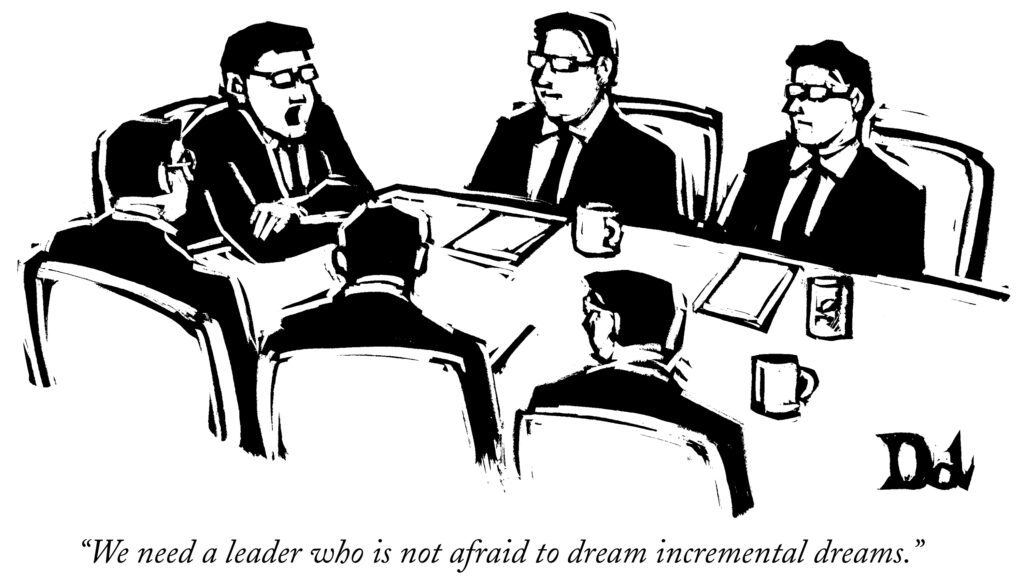
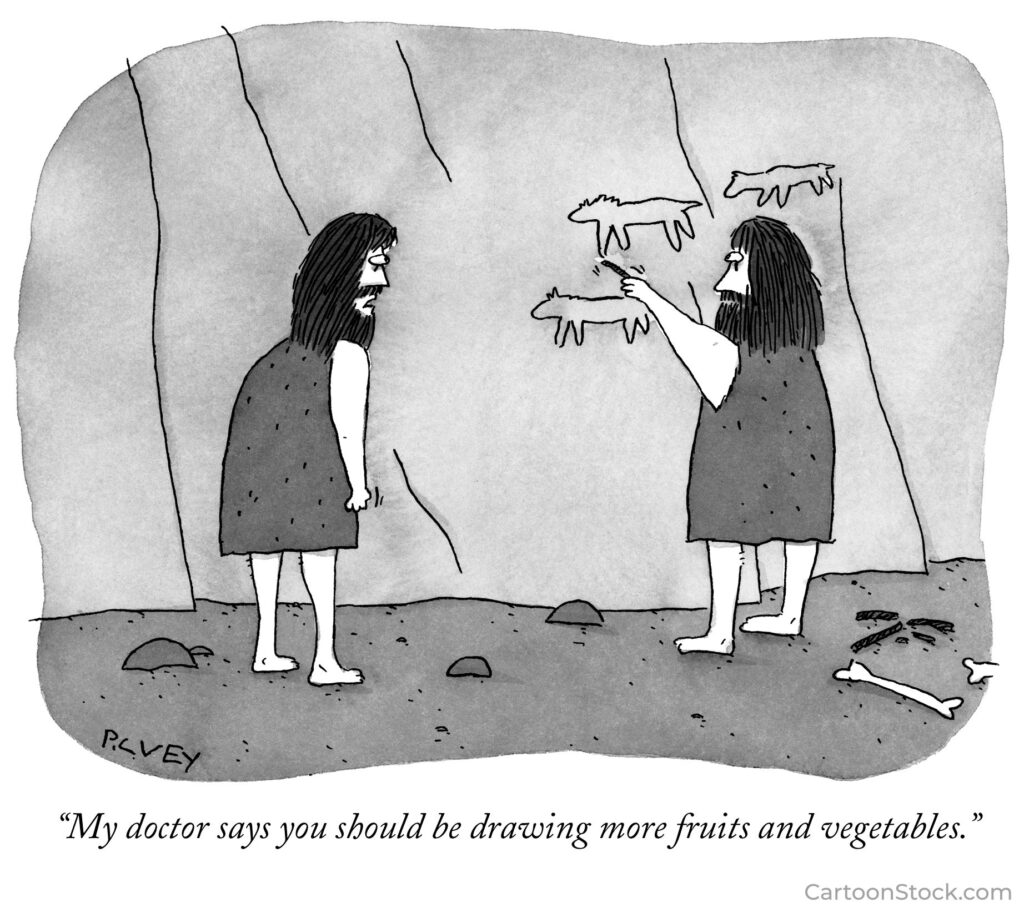
Under licensing agreement with “The New Yorker”
“I’m concerned about you having enough social interactions that are really meaningful and engaging.” (It sounds as if the doctor is prescribing a walk-and-talk along the river.)
Dan’s doctor gave him a chart ranking the benefits of a wide variety of healthy habits. Social engagement topped the list. Even outranking quitting smoking.
The entire system of thought in Quest is designed to answer the questions: How can we live longer with vitality? How can we use our lives to be a blessing and make as great a contribution as possible?
Social constructionism has convinced this recovering lone ranger that, more than anything, we are relational beings. Diana Whitney was the magician in this growth when we were sitting alone, quietly, and I mentioned in passing, “I wish I were better at this intimacy thing… just guarding against attachment, I guess.” Diana smiled and replied, “And what are you doing right now?”
Bob Ireland, who also shares my age, has exactly the right recipe: positivity, purpose, convening conversations of consequence and contributions that do the heart good. He says, “I’m just getting started. I’m gonna work till I can’t.”
This kind of attitude is likely to lengthen his contributory arc, so we can look forward to his greatest contribution yet. His aspiration is to attract millions to his organization and endow it with the idea of “a lifetime commitment of loving care,” for those they serve and the donors who make it possible.
Bob and I are in a race to see who can break the finish-line tape last.
“Would It Be OK If I Sat, While I Speak?”
We know of the power held in an image of the future. Imagining the positive has changed my life.
This awareness first dawned on me when Theresa Bertram applied AI to envisioning the best elderhood possible and crafted an innovative protocol. It did me a lot of good.
I interviewed David with it; he found it profound and life-giving, recalling the story of a time Elise (“Cultures of Peace”) Boulding took the stage in her 90s and asked, “Would it be OK if I sat while I speak?
That image inspires me to be able to ask for a chair someday, too.
There’s plenty of research, including Ken Gergen’s great contributions, all reassuring me that a positive image of aging has everything to do with how it turns out. (Positive Image, Positive Action, anyone?)
Imagine this scene: A researcher watches as a five year-old girl draws a picture of her extended family. The girl grabs bright-colored crayons and carefully draws her smiling parents, brother and sister in the middle of the paper. Then she reaches for dark gray to sketch her grandparents, smaller and off to the side.
Theresa Bertram got wind of this research and thought about what it meant to her: As young as five, we’ve begun to hold images of diminishing as we grow older.
“We’d built our services based on what was best for seniors, as we saw it,” says Theresa. “We were responding to external factors — medical problems, isolation, lack of engagement. And we were focusing on programs for which funding was available.”
“This was under the banner of restoring independence,” Theresa continues. “But it occurred to me that when we deliver meals to people at home, or care for them in retirement communities, we might actually create or perpetuate isolation and dependence. We might inadvertently preempt a different response from their families, their neighborhoods or the community.”
Theresa began to wonder what could happen if they stopped focusing solely on meeting what many consider the needs of seniors: meals and custodial care. She began to reflect on whether the Foundation might make an even more significant contribution to society.
Theresa engaged Kathy Wells, a local consultant who had studied Quest, to conduct an assessment of Theresa’s organization. Theresa saw the assessment as the first step in a conventional strategic planning process.
“But I was struck by the transformational language in Kathy’s report,” says Theresa. “She talked about tapping our latent energy and dreaming about possibilities, rather than beginning with a plan.”
The following month, the board decided to start on the path Kathy had shown them: finding the organization’s future — its best future — using the theory and practices of appreciative inquiry. At the time of signing a six-figure contract, chairman John Sefton said to the board it was “a bold step that requires vision and faith in ourselves” (not in consultants).
It was an especially bold move because the inquiry would not focus on the organization and its programs, how much money it could raise, or even on the needs of the community. Instead, it would explore the larger question of aging in American society. They had shifted from organization to cause.
They would convene a conversation about the best that aging could be.
“An interview protocol was designed to evoke the best experiences of older people — and younger people in the presence of their elders — and to find out what conditions made those experiences possible,” says Theresa. “What we find will let us develop a vision of our organization’s future, based on how we can create the best possible circumstances for the people we serve,” Theresa continues. “In the end, what we learn from this process will make it possible to reframe the whole discussion about aging and begin to create a new set of social expectations.”
The outcome surprised me:
The cornerstone of this effort was an interview protocol that elicited stories of personal experiences with older people, drawing forward the person’s highest hopes for growing older.
Besides the board, in the early stages of this work, some of the staff members were interviewed. Each person had a meaningful, and most unusual, opportunity to consider the personal significance of their day-to-day work. They reflected on their experiences, their lives – their best moment with an elder – their hopes and dreams for themselves and others.
Soon after these interviews, something completely unexpected happened: Theresa was able to stop relying on temporary agencies to fill in its nursing schedules. This was a big deal, I learned, as such low absenteeism is simply unheard of in the field, and temporary nurses are very costly. This development had a measurable positive effect on the financial bottom line. And surely the quality of nursing care benefited from the increased continuity of staffing.
Here’s the most surprising part: Only leaders, as far as middle managers, had been interviewed. No nurses had participated directly, yet they were feeling the effects of the changed atmosphere in their workplace.
Our ideals for the world, once given voice, naturally begin to sing more clearly in our everyday work.
Theresa is now a player on the global stage inspiring others to bring their aspirations to life for what might otherwise have seemed impossible. As Theresa and I stepped to the balcony overlooking the Pacific in San Diego a while back, I said to myself, “Yes, we really are connected to society.”
Along the way I found the positive, strength-based power of AI could be seen in PTG, post-traumatic growth.
As the 2020s began, we were all traumatized to some degree, figuring out how to live in a manner we never had before. . The best example I’ve witnessed of going beyond “bounce-back resilience” and experiencing post-traumatic growth (PTG), comes from a fourteen-year-old who was being bullied in school. Jen Pikard was sponsored by her school’s board chair to come to her first Quest program in Vancouver.
Years later, at her second adventure, she confided to Rufus Woods, a newspaper publisher, that she was interested in medical school. He uttered the fateful words, “I know you can do it.” Two years ago, she was licensed in Canada as Jen Pikard, MD, a board-certified psychiatrist.
Recently, at her fourth retreat in two decades, Jen told me that she’s discovered a new frontier. When she was asked what aspiration she wanted to take on next, I expected she’d say she would be tackling the psychological harm of bullying in schools. However, without hesitation, she replied,
Stigma. I would most love to go after what I feel is impossible: the intense stigma that healthcare professionals perpetuate to each other about mental and behavioral health. Our patients’ worst fears are confirmed when professionals speak with derogatory connotation toward certain diagnoses.
Yes, as if to proclaim that they themselves are not “mentally ill.”
When I asked her what would success look like, she answered,
It would mean a kinder, gentler, more compassionate world. The kinder world I imagined twenty years ago, when I was first asked as a high school student ‘What kind of world do you want?’
Out of her pain, Jen has constructed a valuable contribution—one worthy of who Jen is as a person, and one she can advance via her influence, if not her official role. Now in the Quest facilitation program, her Next step is to make Quest available to patients in the pain clinic, one of the places where she devotes her talents.
Jen’s story brings home the notion that we can reframe pain into post-traumatic growth. In troubling times, I say to myself, “Look back, Jim, you’ve made it through rough seas time and again.” (Historians, by the way, are saying people are looking to them more now to remember the ordeals society has survived.)
Molly Stranahan, psychologist and philanthropic leader, sees the power of turning pain into contribution as she works with children to reduce suffering, one of many examples of post-traumatic growth — PTG.
You can hear her, as she speaks of her advocacy as a thought leader: a child being born and wanted.
Inspiring leaders like these met at a special Quest retreat convened just a few days before the pandemic lockdown. That tiniest of summits grew into an emerging movement to destigmatize mental health. But … surprise! The groundswell of normalizing mental health services became so successful that, as demand rose, it became clear our job had shifted from those who are served, to fortifying those who serve – to retain, restore and recruit – and to attend to their mental wellness.
We’re in this together (that’s getting hard to say)
Isabel Wilkerson, author of Caste: The Origin of Our Discontents, has made us aware of casteism — not just in India but in the U.S. and elsewhere. Vibha, a Quest facilitator from India who only uses her first name so she might be known as a person rather than by her caste, runs live online workshops designed to mitigate the emotional and mental health risks.
Since March 2020, 18,000 people have benefited from her workshops, offered without a formal fee but where participants pay what they choose, in a “currency of trust.”
Vibha of India and Jessica of Siberia
Silent Voices
Rosemary Cairns, who uses her appreciative eye to see “islands of achievement” within “failed states,” shares an instructive tale from her work the world over. This one at a meeting in the remote city of Yellowknife, in Canada’s Northwest Territories.
“While it was a mix of aboriginal and non-aboriginal people, I noticed how many of the aboriginal people weren’t speaking,” Rosemary says. “There seemed to be a certain tone to the comments of many of the non-aboriginal people (although they probably wouldn’t have noticed it). It had to do with that sort of realistic approach—let’s look at how things really are, which in so many aboriginal communities seems to be a catalogue of non-achievement, a wasting of resources, and an unspoken agreement that it will take a long time before things change.”
“In my earlier years, I would have probably said that out loud and alienated three-quarters of the room,” she continues. “But one of the great things about aging is that—like aboriginal elders—I’ve taken to telling stories instead.”
Feeling quite nervous, she says, Rosemary told the group a story of what had happened in Old Crow, a remote aboriginal community in the neighboring northern Yukon territory, during World War II. The people of Old Crow had heard on the radio about the children who were orphaned as a result of the bombing of London. They placed a high value on children and family, so they wanted to make a difference. Despite their remoteness and comparative poverty, the few hundred people living in Old Crow collected about 700 dollars, a very large sum for them. They sent the money to the British High Commissioner in Ottawa, who sent it on to London.
The commissioner actually came to visit Old Crow to thank them for this contribution. They passed the hat and raised another 70 or 80 dollars.
“There was dead silence after I had finished telling this story, a story that I believed described the kind of people who were in the room with me,” Rosemary says. “I wondered whether I’d made a mistake and thought that I must have sounded naive.”
But in telling the story, Rosemary had challenged the unspoken assumptions underlying the conversations in the meeting. The story she had chosen contained irrefutable proof of the capabilities of native communities. That provided a new ground, a new social agreement about who could speak and what they could talk about. And soon a young aboriginal man raised his hand and began to tell of his work in a small community on the other side of the lake.
“He spoke from his heart,” says Rosemary, “from his authentic experience.” That he spoke and how he spoke was even more important than what he said. He opened up the meeting to participation by many of the aboriginal people who had been silent up until then, and to a different level of discussion about development.
One person’s carefully chosen story can interrupt the status quo, replace stagnation with generativity, and create new options for human beings.
When one person’s carefully chosen story interrupted the status quo, Rosemary saw the meeting open to a different level of discussion, creating new options — a breakthrough we can all use in this political era.
Getting legislators to talk to each other
When he told people that was his work, ##Ted Celeste would hear back, “How’s that working for you?”
Ted, like so many, dedicates his life to human cooperation.
Ardeshir Z. Hashmi MD, the Endowed Chair of Geriatric Innovation at Cleveland Clinic, uses this question to empower patients. He offered me a more positive way to see my lack of tears when I learned, at eight-years-old, that my mother had died. He told a story of how that could be a natural reaction, rather than the stoicism I imagined it was — a reframe, if ever there were one.
To keep me vital and contributing, his colleague MaryPatricia Honn has taught me how cognitive health can be nourished by a whole menu of items, including my aerobic routine — and chocolate. A welcome affirmation.
Kim Scott, a national leader in mental wellness, replaces that typical deficit question with a more accurate and compassionate lens. Kim asks, “What happened to you?” in recognition of the circumstances. Instead of pointing a finger of blame at the individual, the focus is on the circumstances, the social determinants, that led to the behavior.
Kim discovered the next breakthrough question: “What is possible for you?” at the individual, family, organization and community levels.
In an era of what’s impossible, hear when Kim discovered a cascade of innovative questions:
Delanna attended her first retreat as a college freshman and now has facilitated a dozen Quick Quests with me.
Delanna holds two of the most common characteristics in those attracted to this way of being: high capabilities and high humility. That’s the balancing act that fascinates me. We want a person to stay grounded, while owning up to their greatness and potential — a recipe for wellness.
With Delana and Anita at my side, quelling my nerves, we went to Canada virtually to work with a group of the premier universities via Zoom. They said they needed an appreciative shot in the arm. That experience has led to an abbreviated form of Quest, one that is portable, with videos, designed to layer into a person’s life, lift their gaze and envision what their success next would look like.
All of this may have begun with philanthropy and the quest to make a difference, but a “frient” (a client who has morphed into a friend) had a breakthrough thought: “A culture of contribution is really what we’re talking about,” suggested Mark Hofman.
In all of this, we can give at least as much credit to the staff members who dedicate their lives to the advancement of the causes that matter to them, as we do to those who give money. It matters little their official role, for it’s the informal influence we’re talking about – their leadership presence when they work aware of their contributory spirit.
Caveat: Quest isn’t built for typical organizational interventions; its focus is less on a collective image of a preferred future derived via consensus. Rather, each individual articulates the kind of world they want and then crafts a compelling picture of the contribution they want to make to it. Strangely, this seemingly circuitous route has worked — by putting the opportunity and agency in the hands of individuals. And this self-efficacy is at the heart of well-being…
The power of these connecting conversations of consequence, inspired by AI, are also seen in an upcoming video about working with legislators. First, the community level where many AI practitioners serve.
Community Development
A civic leader in a small town in Wyoming wanted to use Quest to engage and activate citizens. We asked each person to craft their own compelling picture of the community they wanted, and the contribution they wanted to make to realize it. By the end, they had collectively crafted a clear, concise descriptor of their identity: We’re the “dreamers, doers and diehards.”
(This offshoot of AI was a gratifying way to actualize the research and articles I had been doing way back on quality of life for city magazines in places like San Jose, Pittsburgh, Cleveland and St. Petersburg.)
Contributive Justice
The built-in desire to make a difference is at the heart of a person’s philanthropy, and even a staff’s desire to contribute day-in day-out.
Beyond the workplace and out into the world, contributive justice may be our unseen asset in the pursuit of social justice.
Michael Sandel, political philosopher, posits that when we say social justice, we’re talking about the fairness of what people get. Contributive justice is the opposite – it’s what people give, what they want to contribute to society, even if those contributions seem to be valued less than money.
I’ve seen toe-in-the-carpet self-effacement in folks who’ve devoted their lives to making a difference in the lives of others, often by working in social good organizations or even founding their own. Yet, their contributions actually eclipse in value the money that so many see as paramount. AI resets the tendency to see only what we lack.
We get more juice when we own up to being the kind of people we are, instead of being overwhelmed by the kind of problems we see.
Where do discord, hatred and philanthropic dreaming actually come from?
Could the answer I’ve been looking for be found where the resource-rich bonobos and resource-poor chimps live such different lives?
I found an insight that intrigued me from an evolutionary anthropologist, Brian Hare at Duke University, and his wife, research scientist Vanessa Woods. It’s a tall leap from humanity, but points toward a worthwhile idea for me: Among animals, we find aggressive chimpanzees north of the Congo River and more peaceful bonobos south of the river. How is it that these two species that appear identical are so different in behavior? In a word, resources.
Chimpanzees live where food is scarcer. Bonobos live where they don’t have to worry as much about food or compete for resources.
On a human level, acknowledging how much we have going for us, even when things seem to have gone badly, can be a strategy to alleviate conflict and lift health and vitality.
In another part of Africa, it’s said that among members of the Babemba tribe, when someone acts outside of the norms, instead of punishment, they are met with praise for their human qualities. A group surrounds the person, and shouts out attributes they admire about the person. Imagine the effect if you were in the center of that circle, expecting to be chastised!
When people who are stressed are reminded of their tailwinds — their resources — the headwinds seem less intense; they stand in that power, capable of more than if they had been beaten down.
Might that be the path to avoiding the worst of collective fates, even a new kind of Civil War, if each of us can simply feel worthy?
When we feel full and well-grounded, we can take on anything.
On my own career trajectory, here’s why I stepped away from the income and exhilaration of philanthropic capital campaigning in favor of real-life experience in the theoretical ground we share.
An Architect of My Identity: How Social Constructionism Built Me
We’re all influenced by who we hang out with.
I wanted vivid thoughts to lead to a fresh voice, still grounded in what I knew from years of experience. I wanted my thinking to be clear, human and undiluted by what others were talking about in the fundraising world.
That’s saying it nicely. I get an icky feeling on my skin, and my shoulders rise in indignation, when I hear of the objectification in terms like, “deep pockets” or “targets.” I was appalled by the distasteful manipulation (pulling the wool over the eyes of people who knew what was being done to them) when trust is our aim.
A while back, a smart colleague who I had met at Case Western University and then turned to consulting was reported on the front page of the “Wall Street Journal” having said, “If they don’t grab the table and their knuckles turn white, you didn’t ask for enough.” The next day, the WSJ reported he was fired.
That type of culture is why I withdrew from the field. I broke away from the negativity, cut back on public speaking and started to concentrate on offering private workshops instead. In contrast to “exhaling” at keynotes, the workshop format let me “inhale,” learning more every time from the amazing people who joined us. And a positive ripple effect was created when workshop “alums” would nominate other HiPo (High Potential) people to be invited to the next offering.
Appreciative Inquiry: We’re All Human – Let’s Keep It That Way.
Social constructionism and AI. I’m always learning more about these sweet onions, as I keep unpeeling them. So, I’ve tried to put my understanding of how AI is built on a foundation of social constructionism in an acronym. What do you think?
SCAI (Social Constructionism and Appreciative Inquiry — pronounced “Sky”) is an attempt to meld social constructionism (SC) and appreciative inquiry (AI), giving credit to social constructionism as the meta-theory.
Appreciative inquiry introduced me to a way of constructing my world – and rocked it. I was talking with a colleague about AI the other day. “David had me at “appreciation,” I confessed. “He says it’s code for love. That would have been enough, but then “inquiry” became even more important. It reminded me of my first job as an inquiring journalist. It underscored the art of psychotherapy, too: Simply put, stay curious, ask questions.
Instead of problematizing everything, which was too often my old inclination, I now had the academic grounding, worldview and a way to do it – a practice to approach problems as puzzles, by assuming strength, capability and potential.
Luckily for me, I found that old dogs can learn new worldviews. For me, it all began with the power of knowing less and asking more.
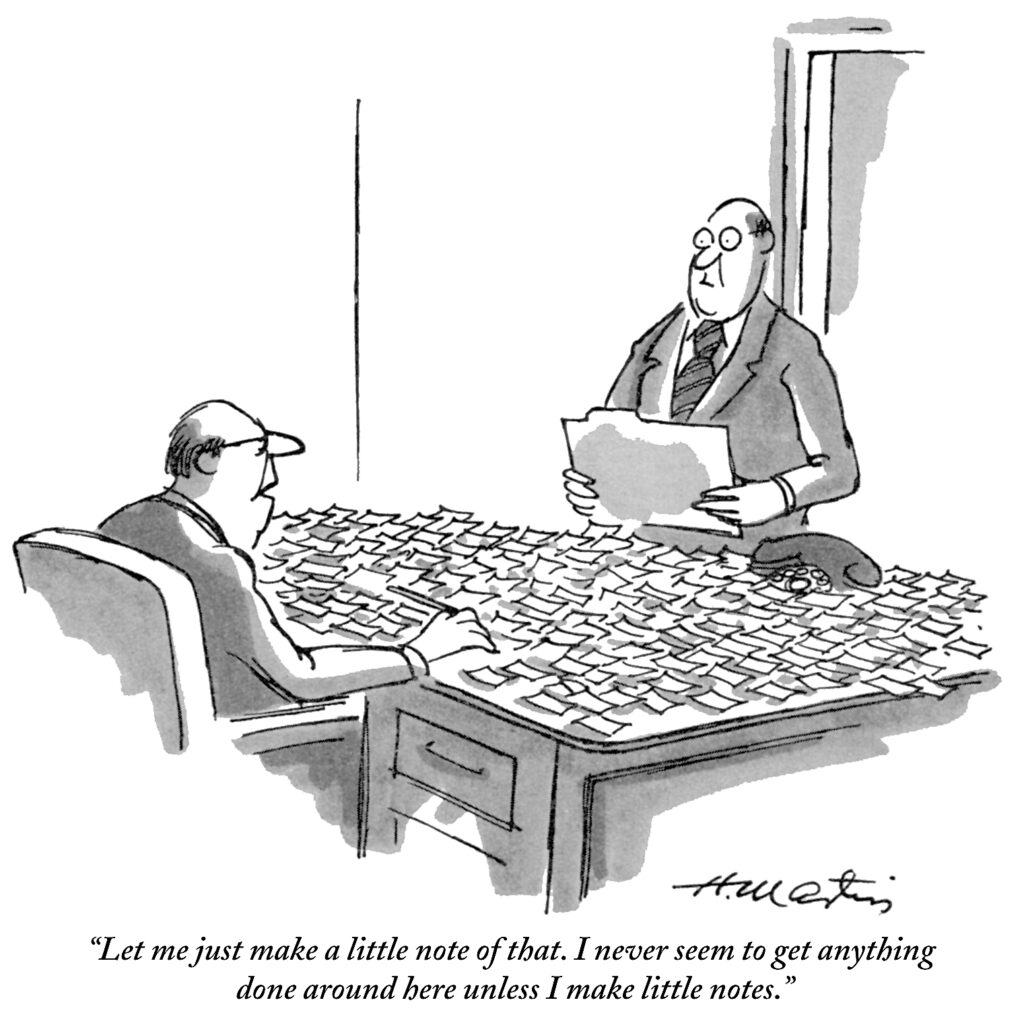
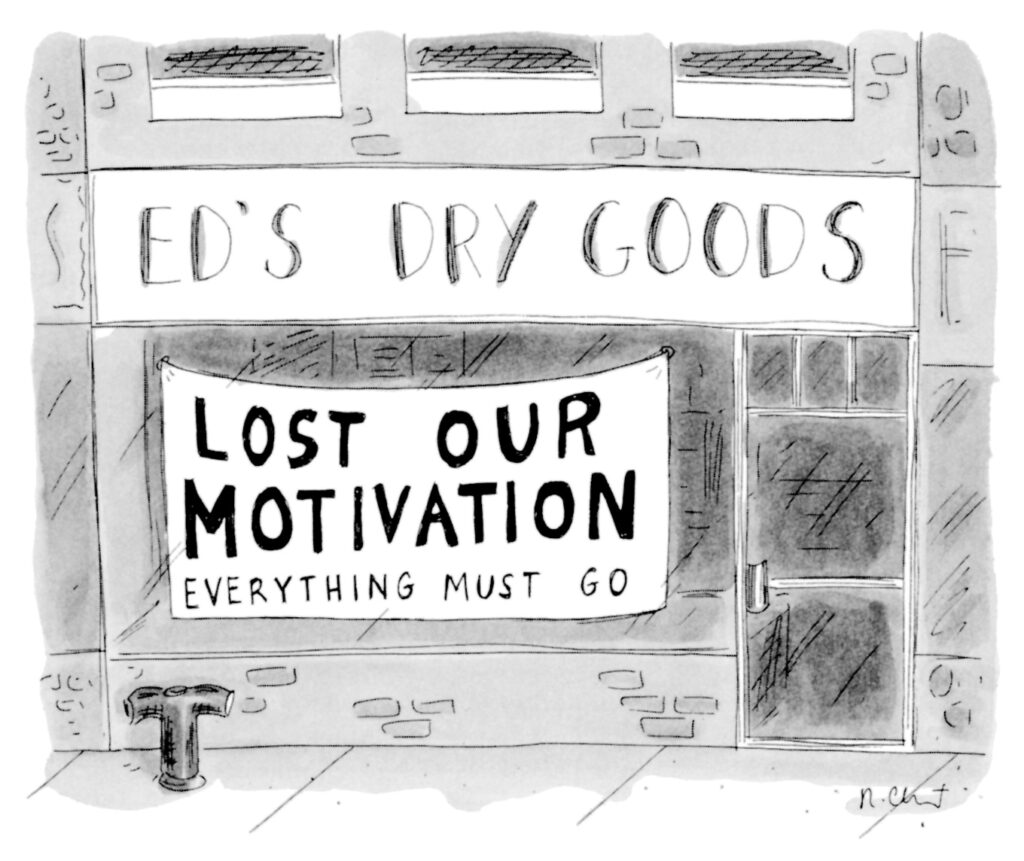
Under licensing agreement with “The New Yorker”
Kathy Wells and I were working with a university in Minnesota. She interviewed a major donor about his experiences as a contributor. Curious to find the heart of his deep connection with the university’s mission and work and for society, she wanted to know his highest hopes for the university and himself. No one had ever asked this question before.
“Harvard has asked me, they’ve asked me many times — but always for money,” he concluded. “Neither Harvard nor any other organization has ever asked what’s important to me. Hamline will get all of my money, and Harvard will get no more.”
Here’s the backstory.
Barney Saunders, a Harvard alum, was vice chair of the largest privately-held company in the world. Kathy Wells and I met up with Barney in St. Paul, Minnesota, where he had just become chair of the board of Hamline University.
The university was in the early stages of preparing for a capital campaign, and Kathy and I were there to work with them in laying the groundwork.
Kathy interviewed Barney about his experience as a contributor. Since the interview was on behalf of a university, she also asked him about his experiences with learning. She was curious to find out about his highest hopes for society, and what might be at the heart of his deep connection with the university’s mission and work.
Such questions are rare in the field of “fundraising,” a field which tends to focus on the “needs” of an organization, rather than the experiences, hopes, and dreams of the individual. But wouldn’t an institution of higher learning care about the learning of its board members?
After the interview, Barney was scratching his head. “Something happened here, but I don’t know what it was.”
He reflected on the experience, and after several talks with the university’s vice president, Dan Loritz (more about his trajectory in a moment), he concluded: “Harvard has asked me, they’ve asked me many times — but always for money. Neither Harvard, nor any other organization has ever asked what’s important to me. Hamline will get all of my money, and Harvard will get no more.”
Barney went on to make a contribution of such financial and moral significance that it set the pace for the largest capital campaign in the university’s history, by far. So much momentum was created that the university increased the goal. Twice.
At the celebration, tuxedos and gowns, I saw on Barney’s face that same little smile I’d seen on the streets of Shelby — a town I tell of in “What Kind of World Do You Want?” — one that’s filled with folks who knew they mattered.
When something so transformative happens for a person, it also shifts how they think about raising money. Barney saw that it was he who had received a gift: the opportunity to reflect on the meaning of his contributions — and even on the meaning of his life.
“This is how I want to treat others,” he said. “All trustees should be interviewed as I was. Not for what more they can do for the university, but as a gift to them for what they’ve already done.”
Barney expanded my understanding of the importance of focusing on meaning — the individual’s dreams for themselves and society, and how the institution can be a vehicle to realize those dreams. Such inquiry activates the built-in desire to invest one’s community and self, in a manner that aligns with our aspirations for the world.
In the end, money follows meaning. And you can bet your boots that the more significant and profound the meaning, the more significant and profound the money.
Here’s an article that tells how Dan Loritz partnered with Barney Saunders
How Asking Just a Few of the Right Questions Sparked Breakthrough Philanthropic Leadership
Dan Loritz faced unusual challenges in getting his university’s largest-ever capital campaign off the ground. Two brief AI-inspired workshops and a strategically focused on-site visit provided the spark. A carefully designed interview quickly surfaced a surprising leadership gift that set the pace for the campaign.
This high-engagement approach let Dan skip the conventional feasibility study and case for support, meet the campaign goal, increase it, and then far surpass the new goal. Take-aways here for institutions large and small.
A Roundabout Beginning
Our relationship with Dan Loritz, Vice President Emeritus of Hamline University, and now Senior Fellow and President, Center for Policy Design, St. Paul, Minnesota, really began in the pencil drawer of his desk.
For years, he’d kept in it a reminder to himself — a clipping from The Raising of Money: “organizations have no needs.”
Then he took the next step and became an early subscriber to The Philanthropic Quest series.
And that led one day to a phone conversation with Jim Lord. Impressed with Dan’s intelligence and curiosity, Jim invited him to a Quest Retreat. Dan soon found himself flying all the way from his home in Minnesota to Cambridge University in England.
At Cambridge, Dan stood out in the intimate yet global group — always 100 percent engaged, sometimes even intense. He was inspired by sharing an interview experience with Michael Bleks (then in the early days of co-founding the first private university in Germany).
Dan could see he was onto something … and the wheels started turning.
The Meeting
A year or so passed and Dan flew to a second workshop in Jacksonville, Florida. This time he wanted to make a case to Jim for doing some work together on the Hamline campus, so he asked for a private meeting with him and Kathy Wells, a consultant studying with Jim.
Now, you might expect someone like Dan to carry with him a list of the university’s top ten funding needs, or maybe his top ten “prospects.” Instead, he pulled out of his breast pocket a list of everything Hamline has going for it — a letter-sized sheet of paper completely covered in the smallest handwriting you can imagine.
“When I’m on campus, the problems seem so real,” he said. “There’s always someone going on and on about some urgent need or looming crisis. But when I step off campus, I can see the university as the beacon of hope that it is. And that’s the reality I stand in when I meet with people in the community — and try to bring back to campus.”
Dan said he looks at his sheet of paper every day, knowing it takes intentional action to stay true to such confidence and idealism.
Even with all that confidence, Dan wanted support as he readied for the largest campaign in the university’s history. He faced some challenges not every institution encounters: It had been quite a while since their last campaign, so they couldn’t build on recent success. They hadn’t found any obvious candidates for the leadership gift. And their small advancement team had no campaign experience.
Dan made a compelling case, but Jim’s calendar was already too full. So the meeting ended with Jim saying, with regret, “Well, Dan, if you can hold off, we’ll see what we can do … but it might be a while.”
Answering the Call
Dan ended up waiting close to a year, putting the brakes on Hamline’s campaign so he’d have a chance to start it off right.
At long last, Jim and Kathy were able to call Dan with good news: They were so compelled by Dan and his ideas, they’d make time for an on-campus visit, as long as it was high-leverage and would provide extreme value to the university.
So the three of them put their heads together and agreed on a brief, focused engagement designed to set the stage for the campaign.
On Campus, at Last
The design for the service was straightforward: Kathy and Jim would each interview three carefully selected people, using a special “Philanthropic Quest” interview protocol – inspired by AI – designed to discover what was at the heart of their connection with Hamline’s mission and work, and what their highest hopes were for education and for society.
A few other meetings were on the docket as well — to engage deans and other university leaders — but these six one-on-one, high-stakes relationships were the main event.
One of those interviewed by Kathy was Barney Saunders, who you just met; at time, he was the chair of Hamline’s board, the vice chair of the largest privately-held company in the world and a Harvard alum.
The two spent an intense yet enjoyable time together, a true “conversation of consequence.” The structured interview, plus Kathy’s appreciative presence, gave Barney a chance to articulate fully (for the first time in his life) why he was so devoted to the cause of education — and how that personal “why” might be best expressed through his relationship with Hamline.
After the interview, Barney called Dan. “What was that? What just happened?” Dan had several more conversations with him during the week after Jim and Kathy left campus. Thanks to Dan’s workshop experiences, he was well-prepared to handle those conversations and work with Barney to make meaning of the interview and what it had revealed about Barney’s commitment to Hamline.
Surprising Results
After these conversations, Barney made a remarkable observation (one that sadly reflects the experience of all too many philanthropists):
Harvard has asked me, they’ve asked me many times, but always for money. Neither Harvard nor any other organization has ever asked what’s important to me. Hamline University will get all of my money, and Harvard will get no more.
And he meant it, in a big way. Within a week, he had conveyed his first million-dollar gift to Hamline. He went on to make further contributions of such financial and moral significance that he set the pace for the largest capital campaign by far in the university’s history.
So much momentum was created that the university increased the goal and went beyond even that mark. All without the usual feasibility study, case for support, or campaign consultant.
The workshops Dan had attended and the brief visit by Jim and Kathy had delivered the highest-value result: a transformative leadership gift that would set the standard for the entire campaign. At the same time, enough capacity had been built within the university to carry the campaign to an extraordinarily successful conclusion — without the usual complexities most people just assume are “the way things have to be done.”
Why make things more difficult than they have to be?
Since my first day working in philanthropy over 50 years ago, I have been asking that deceptively simple question out loud: Why do people ‘give away’ their money?” These acts give us powerful insight into human motivations, since they often seem counterintuitive and against self-interest.
It has become my meta-question, one worthy of decades of inquiry – a question big enough to last a lifetime.
These inquiries have taught me more about human motivation – the built-in desire to make a difference, in all settings – than all the books, courses and experts I’ve encountered.
But I’ve given up on finding the answer to this unusual behavior. Better to inquire of the person than to know a formula. Better “Humble Inquiry,” as Ed Schein titled his book.
Let them tell you.
The thing is, asking “why do you give?” point blank seems to always fall short. “Why” results in lip-service, empty though well-intended clichés like, “It’s important to give back.”
But AI gives us the magic of the narrative, which unlocks their hearts (and mine), as we delve into their story. Asking people to tell a story reveals hidden clarity and potential that the storyteller might not even realize is there.
When my heart opens, modeling for the other person, no matter how close to the vest they play it, their heart opens, too. Mirror neurons.
Coming in the back door in this way leads us to a more profound answer. Once they own up to the kind of giving person they are, that often reveals unseen yet irrefutable proof of their vital core – a direct path to fortifying the best in a fellow human being. And that gift to them can seed the human impulse of reciprocity.
Asking those kinds of questions has turned into a life’s work that led to launching the Quest Strategic Retreat. At my first Quest, David Cooperrider was attending the tiny group because of his interest in philanthropy, as both a learner and as an AI guide. He asked, “The field speaks of transformation. But only of the donor’s. What about the organization’s?” And then he drew the most useful Venn diagram for our work.
The Art of AI: Photography
Just as AI asks us to isolate a highpoint, the camera allows us to focus on the most important part of the scene, at a decisive moment, and preserve it. The depth of field controls what is figural, it pops out; the rest becomes a diffuse background, context that is always there.
We can also crop the image to further spotlight the core of the scene so that the idealized image moves viewers. In portraits and candids, our inquiry is into a person’s life as shown in their face. The catchlight reflected in their eyes brings us closer to who they are. Ahhh.
Thinking of one’s self as an artist can be illuminating, just as Nancy Cooperrider’s art and weaving suggested how art appreciation might inform David’s innovation.
You, as Nourishment
Cellular biology teaches us that the cell walls of a living organism can be permeated to allow nourishment to enter. In a similar vein, those of us who embrace this this work can bring something different to every system we meet.
Gestalt theory is at the center of this philosophy, and I credit John Carter for first teaching me the principle that the difference we bring can be the nutrients the system craves to grow.
At 21, I had met John’s friend, Carolyn Lukensmeyer. Carolyn was facilitating my first T-Group when she opened my mind about the possibilities to contribute with just one durable word: choicefulness. Think about that for a moment, if you will. We are in a state of being full of choice, full of ways we can nourish others.
And that food is “difference.” Something different nourishes. If what we offer is the same as what’s inside the cell, the organism likely withers and dies. But when we show up with a different worldview, theory or practice, the organism can flourish.
Besides AI itself – a disrupter to the status quo if there ever were one – how does your presence nourish the systems you enter?
What is hidden in your potential? Even with all you’ve contributed, how will you grow your contribution in social innovation? (Maybe it’s time for an AI interview into yourself?)
What can happen when we put away our presentations and connect with people in a different way?
Leadership philanthropy doesn’t happen in a vacuum. Individuals and families of wealth have many advisors — and there’s much to learn from the experience of those professionals about building relationships of trust and influence.
Go behind the scenes with Jay Hughes, high-level advisor and confidante to families of wealth. His mentoring of Charlie Collier, leading philanthropic advisor at Harvard, has had a lasting influence at the highest levels of the development profession.
Take-aways here for all development officers who want to strengthen their own influence as trusted advisors.
The opportunity almost everyone misses
For many years, Jay practiced law in New York. Families he advised would ask him to sit in on “beauty contests” — the selection of a new investment manager, counsel, or other professional.
“They would come with their heavy books and deliver a skilled presentation,” Jay says. “Fifty minutes to present, five minutes for questions, and then we had to scoot them out of the room so the next group could come in.”
“Almost always, there would be one person who’d come with a book they never opened. Instead, they’d begin the conversation by saying something like, ‘Who are you?’
“I can say from sitting through many, many of these meetings, they were the ones who got the business. They were not slick people. And they were no smarter than the others. They were interested and curious.”
When you think about it, it’s not surprising that the families chose the person who showed genuine interest in them. And yet most of the candidates chose to waste their one opportunity to connect with the people they wanted to serve.
A shift to “qualitative relationships”
Along these lines, Jay tells of a time when he mentored an up-and-coming investment manager. Eager for growth and development, the investment manager wanted to take a “road less traveled” and create what Jay calls “qualitative relationships” with clients.
Jay’s mentee called him one day and said, “Jay, a gentleman in Chicago has invited me to meet with him. I want to try out this ‘new me.’ I don’t care if I get the business. I want to do something different, see if I can practice what you and I have been talking about.”
Jay offered some suggestions, a possible approach, a question that could be asked. A week went by and Jay got an email: “I’ve got to talk to you.”
Jay thought, “Well, OK. This could have gone very well, or gone very badly.”
The two got on Skype. Jay asked, “Well, how did it go?”
His mentee replied, “Well, I did exactly what you suggested, Jay, I asked that one question. It was the hardest thing I’ve done in years. Then I was quiet. I didn’t say one more thing. After a few moments, the man looked at me and opened the door to an in-depth conversation — not about his money, but about his family, his goals, his aspirations.”
And, of course, the end of the story: “You know, I got the business.” (In fact, he got more assets than the man had originally intended to assign him.)
It took courage for Jay’s mentee to take that leap into a different kind of relationship. Courage that was bolstered by his relationship with Jay and their shared exploration of new ways of relating.
What an insight this offers for the development officer who thinks only about presentation, without allowing their own curiosity, their own empathy to show up. How many opportunities are missed to make this about the other person, rather than about the development officer or the institution?
It takes a bit of courage to shift the focus from “How can I get my story right, as good and as polished as I can,” to “Could I just listen to their story?”
All the more so in the face of institutional demands, metrics, and expectations. Again, mentorship can play a big part, as when Jay mentored Charlie Collier in his work at Harvard.
Jay’s relationship with Charlie began at a conference they both attended, many years ago. They didn’t know each other, they just knew of each other.
At the time, Jay was just starting to experiment with family conversations that went beyond money. “Charlie was tremendously excited by the conversation he heard me convening, this different way of working with families,” says Jay.
When Charlie went back to Harvard, he started to put the insights from Jay into practice. “He used a kind of systems approach, looking at all aspects of the family’s life in a very gentle, very humane way,” Jay recalls. “He would go out and visit the families that were generous to Harvard or might be interested in being more generous. As a response from Harvard, Charlie would take them through their value systems and their decision-making. In effect, he would ask: ‘How can I help you and your family prosper?’”
“And it was incredibly successful. For Charlie, because it fulfilled his mission of service. And very successful for Harvard, as I understand it.”
Charlie’s work also began a conversation about the quality of life of development officers. Could they have a quality of professional life that focuses on meaning and transcends metrics, without detracting from their quantitative results?
When such questions are raised in the development profession, most people say, “Let’s just get on with the work.” Or maybe, “Well, that’s all very interesting and you pulled it off, but I’m sure if I try it, it’s going to slow down my conversations with these families. We won’t get to the heart of the matter, which is getting them to write a check, and I won’t meet my dollar goals.”
Those responses are understandable. But at least for Charlie and those who have followed his example, they found that the quality of their lives was better and the results they obtained were better, too — because they were connecting with people in a more significant way.
“There was no doubt that Harvard was sending Charlie out with a mission,” as Jay puts it. “But Charlie exercised a kind of altruism. He brought thoughts, ideas, and techniques to families that helped them be more effective among themselves — without in any way diminishing his responsibility to Harvard.”
Maybe not everyone can pull it off.
I’m not saying everybody is Jim Lord, and I’m not saying everybody is Charlie Collier. Of course not. But I think there is, in Charlie’s life, a way of being that can open up for some people.
Most of these really good things that happen, happen without much fanfare. They happen because somebody thinks, ‘Gee, there’s a better way to do this. I’m doing all right. But it’s not satisfying to me. I don’t feel the human connection is sufficient.’
Between you, Pam, myself and Charlie, is this larger view of what’s really going on.
Jay Hughes
Jay Hughes, renowned advisor to families of wealth, is a philosopher and frequent speaker on the growth of families’ human, intellectual, social, spiritual, and financial capital. His many writings include the acclaimed classic Family Wealth. (Jay attended a workshop with us to envision his own contribution to society and we’ve been in close conversation ever since.)
Top Two Reasons to Raise Your Fees (If You’re Not “Just in It for the Money”)
Your clients get the better results we want for AI.
It’s true. Low-fee or pro bono work often ends in disappointment. Higher-priced services often lead to better results. One reason: Higher fees command more of your clients’ attention. They take the engagement more seriously when they have more skin in the game. So, they’ll give it their all. They’ll take action. They’ll make sure they get results. (Better results also lead to happier clients, better testimonials and more referrals for you.)
Your clients see themselves differently.
Here’s another reason for those better results: When a client makes a big investment in their future, it’s a rite of passage. They’ve decided that they’re serious about their future. They can say to themselves: “I’m worth that much. I’m a high-level person because I have such a high-level partner.” (Or “We are worth that much.”) That gives them more confidence in themselves — crucial to their successful action. Afterall, AI is all about emboldening the identity and courage of the leaders it touches.
More reasons? You can count on it. Glad to send you our “Top 10 Reasons to Raise Your Fees.”
The author’s quest
Inquiring into the best of past experiences with clients is the best way to move toward a preferred future. As I’ve tried, like others, to popularize AI, all of my writing has been directed to professionals outside the field of organization development. Oddly enough, consultants and authors in OD, and rarely in philanthropy, have more often come to Cleveland for a day devoted to their practices.
Although authorship was rarely spoken of during our time together, several folks did write books afterward…
Recently, Brenda Reynolds remarked to me, “I was stretched to dream about possibilities and grow my confidence, to reach for new and bigger aspirations I previously felt were out of reach.” Among a growing list of contributions, is her 5-star Amazon bestseller, “TBD: To Be Determined — Your Guide to Managing Change with Ease.”
Each of these pioneers have such stories to tell about how they pulled it off. Judi, for one, has made her place in the world of novels and children’s literature. After Questing, quite a few folks, like Judi, then entered the AI Certification Program.
Whether consulting, coaching, authoring or speaking, AI gives us a way to prove to a person that they already have experience in whatever-it-is that scares the heebie-jeebies out of them – especially, I’ve learned, in the case of “fundraising.”
It can simply take discovering in their story how they have metaphorically done it before. It’s also why the heroic journey is at the heart of Quest.
For Speakers, Appreciation Works Better Than Complaint. Who Would Have Thought?
Here’s another offshoot – a big one: When it’s time to step to the front of the room.
For my first two engagements, I was sure I had the flu, until my last word when they surprised me with a thunderous sitting ovation.
But, a decade later, a major hospital brought me in for a conference, and, at the first break, they suggested I was past my prime. The guy actually said that. I was 32 but looked much older then, it seems.
Oh, wait. That morning I had a two-hour massage. Ah-ha!
So that’s why I was speaking so slowly. I was in Happy Land. They were not. They punished me, they really did, when they could have found just one little thing to praise. I rallied to the danger, but less than I would have, had I heard a confidence-building word or two.
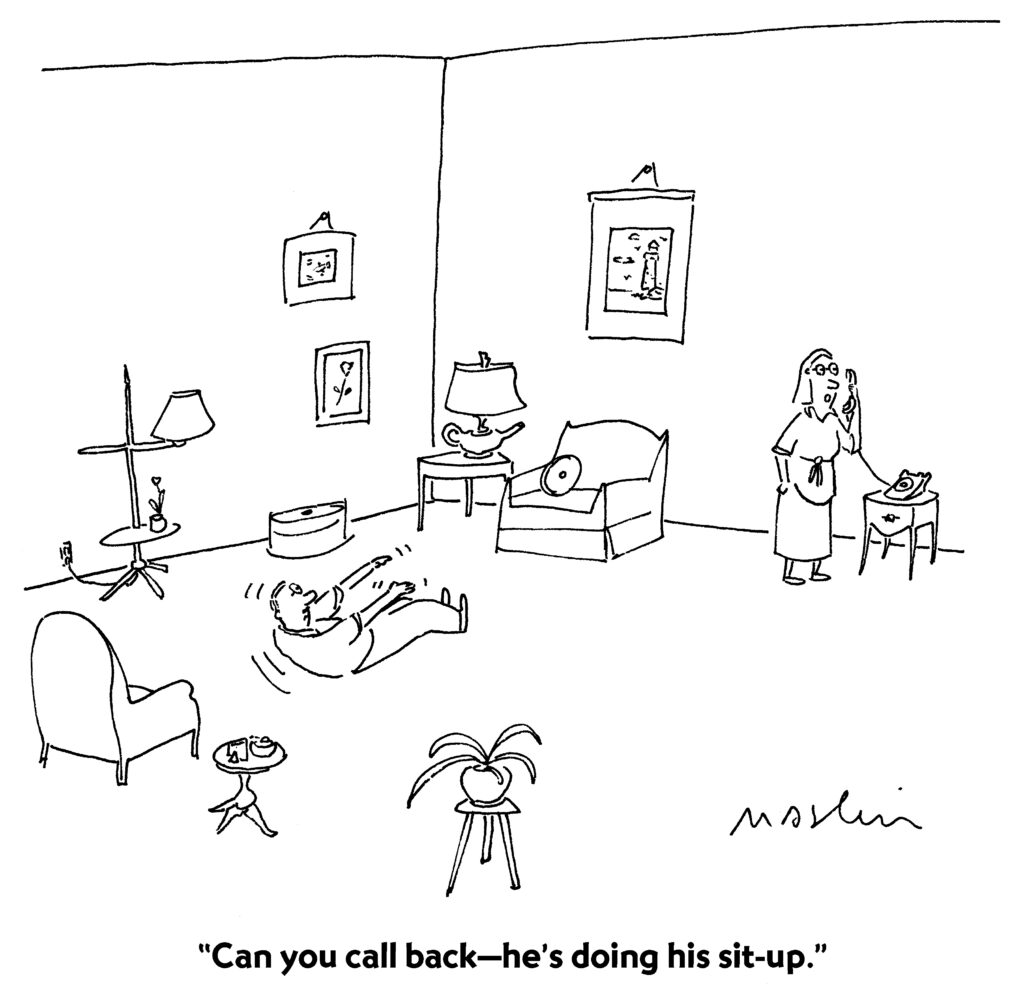
Under licensing agreement with “The New Yorker”
How about an endnote speech to conclude a conference in Johannesburg? They wanted to send them home inspired, and thought I was just the ticket. The same thing happened – a wonderful relaxing massage.
It looked to me like they were nodding in agreement, but maybe they were nodding off to sleep. The South African convener let me know their displeasure just as the tough hospital guy did.
(I now say to myself, “Jim, next time, just live with the butterflies and quiet them after the gig.”)
Now imagine, how could I advance a speaker’s trajectory of success, if not for times like these?
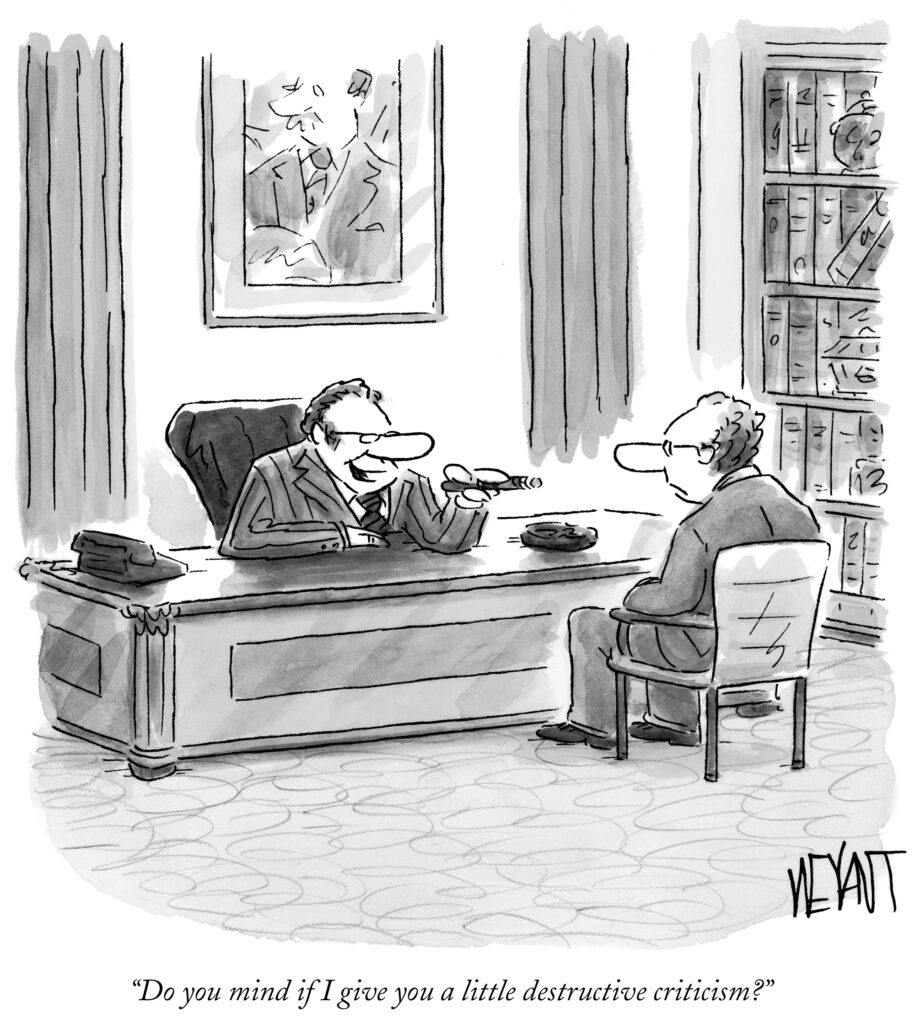
Anxious experiences, when criticism was expressed and praise withheld, showed me that criticism is not always as constructive as it’s chalked up to be. In fact, it can be destructive. A few words of encouragement, though? Those are the vibes I crave. You?
Praise is powerful, even when hard to justify. And that’s our job: being good – and getting better – at seeing the unseen, even a glimmer. Strengths always win, and when it comes to raising money, telling people how badly it’s going is far from the most effective strategy.
When palms turn sweaty, strengths win over criticism.
When John told me he wasn’t going to correct me, I thought, “What?? If I’m going to get better, I have to know what I’m doing wrong.” But it was a bit late to try to negotiate his approach.
Under licensing agreement with “The New Yorker”
Sure enough, at the first break the next day, John had only had sincere praise. In fact, all he gave me was a list of skills he saw and a suggestion that I practice them more. I found myself feeling pretty good. I mean, here was the expert giving me evidence of how capable I was!
A little later in the day, he did offer me one opportunity for improvement that intrigued me.
“Did you notice, Jim, that people paid even more attention that time you stepped away from your notes? Would you want to try that again?”
Take a close look at what John said. He pointed out a moment when I was doing something he knew to be effective, more than a decade before I found AI.
I was clinging to the podium for dear life – so, believe me, it would’ve been a very brief moment that he noticed. But a small glimpse of hope was all it took to gain a foothold of confidence, leading to the next step, then the next…
That’s the power of someone seeing something in you, even if it’s just a flicker of promise you don’t yet recognize yourself. And, just like that, a series of small wins can chart an entire trajectory.
I Can Do Something Harrison Ford Can’t?!
Eight years later, I’m in a living room in Santa Monica, speaking with the board of Conservation International.
As we’re about to take a break, the actor Harrison Ford says, “You can ask me to do anything for this cause, just don’t ask me to speak extemporaneously like Jim Lord just did. Give me a script, and I’m fine.”
If he had only known where I’d come from.
How Does Social Constructionism Figure into My Quest?
On my own career trajectory, I got a megadose of real-life experience in the theoretical ground shared between AI and social constructionism..
I’m a curious person (pun intended). Always learning, questioning assumptions, looking for fresh ideas and paradigms – and wondering: How do we know this? How do we know what’s possible?
And what about us? Do we even know what our true potential is? Do you know yours? Do I know mine?
After all – and this is the most basic question — why is it that you and I want to make a difference and affect people? Why do we invest ourselves in ideas and causes?
From the beginning, I’ve been fascinated by questions like these, about what could be possible for people who want to grow and how they can realize potential by investing themselves with more oomph. I’ve been intrigued with why people invest in a cause, in the first place. Why do they invest themselves – their money, their attention…?
Your expedition in life has likely been like mine, with dozens of unexpected twists, turns and bumps.
For me, coming of age in the time of the human potential movement meant potentiality was exciting, and so was taking on seemingly impossible aspirations – while inspiring others to do the same.
The task has been to invoke “use of self as instrument,” so that my personhood and presence inspire growth in others. Likely for you too.
That sense of self-efficacy is the key to pursue dreams that seem unattainable and then watch them come to life, just by asking a few unusual questions.
I found the answer, no surprise, in knowing less and asking more. Beginner’s mind. That’s where AI comes into the picture, custom-made for my quest and likely yours, too.
The magical thing about inquiry is its limitlessness. Pogo, in the comic strip, was talking about us when he proclaimed that with AI we’re facing “insurmountable opportunities.” The late Jane Watkins put it just as vividly: “… like mosquitoes in a nudist colony. So much opportunity!”
I know the way our AI nourishes us will certainly affect my life more than that new-fangled tech one. (In fact, high tech is going to take all the high touch it can get, agreed?)
After all, our AI provides three of the key ingredients for longevity with vitality: positivity, purpose and connecting conversations of consequence. Quest explicitly organizes around a person’s contributions that enliven those three.
The AI Diet
A good place to start this conversation is with nourishment. Dr. Joel Fuhrman, the nutrition physician, suggests that the better “nutriated” we are, the better choices we make. And one way AI will bring longevity-with-vitality is, no surprise, via what I eat. After all, the aura of AI itself is a life-giving force.
Nourish to flourish.
Instead of being so damn restrictive and self-flagellating, this diet is about adding something: A large salad starts the path of nutritarianism. David joined me in this experiment, and I’m fascinated with how we can flourish systems, if we start with the self and expand outward looking for what can nourish systems.
If you’re with me so far, how about giving yourself a pause. Climb out of that fast-moving river of life, and take a walk-and-talk with me along the river’s edge and let’s see what we can find.